

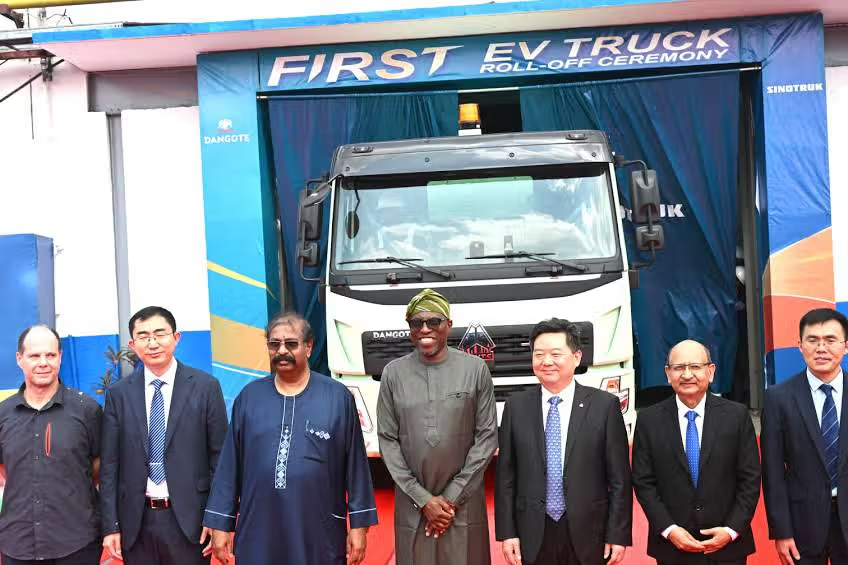
The vehicle was unveiled at the company’s assembly facility in Ikeja, Lagos, according to a statement issued by the Dangote Group on Sunday.
The group described the development as a historic milestone for Nigeria’s automotive industry, signalling a new era of green mobility, local manufacturing and sustainable transportation across Nigeria and West Africa.
The rollout expands the Dangote-Sinotruk joint venture (JV) beyond conventional commercial vehicle assembly into electric mobility, adding electric heavy-duty trucks to its existing range of trucks, tippers, light trucks, pick-ups and buses.
Speaking at the unveiling, Vice-President of Dangote Industries Limited, Devakumar Edwin, said the introduction of electric commercial vehicles marked another milestone in the evolution of the joint venture.
He said the move demonstrated the group’s commitment to adopting emerging technologies that could create value for customers while supporting Nigeria’s environmental objectives.
Edwin explained that the Dangote-Sinotruk partnership was established to build a world-class commercial vehicle business in Nigeria, strengthen local assembly capabilities, facilitate technology transfer, create employment and contribute to the country’s industrial development.
He said the group had evaluated several Chinese truck manufacturers before selecting Sinotruk as its technology partner.
“Today, we are taking an important further step as the global economy is looking for sustainable business, that is, vehicles which will also be protective of the environment. So, we went into CNG technology and now we are going into the electric technology. This is a technology which is revolutionising the whole world,” Edwin said.
He added that the expansion into electric commercial vehicles reflected the joint venture’s determination to keep pace with technological developments in the global automotive industry while providing customers with more transportation options.
According to him, electric commercial vehicles could reduce operating costs and tailpipe emissions, depending on their applications, electricity costs and the availability of charging infrastructure.
“The electric commercial vehicle offers the potential for lowering the operating cost and reducing the tailpipe emissions. Depending on the application, the electricity cost and the charging infrastructure, it is going to be highly beneficial to the people,” he said.
Edwin disclosed that Dangote Sinotruk was preparing the infrastructure and technical support required to facilitate the deployment of electric commercial vehicles in Nigeria.
He said successful adoption would depend on reliable charging facilities, technical expertise, spare parts availability and efficient after-sales services.
“We recognise that this successful adoption will also require reliable charging facilities, technical expertise and spare parts and a strong after-sales support. So, we are already getting ready with a strong after-sales support. We are setting up our team,” he said.
He added that the company would support customers with charging infrastructure and technical expertise while collaborating with government stakeholders, business partners and customers to develop Nigeria’s electric vehicle ecosystem.
Also speaking, President of Sinotruk Group, Liu Wei, described the rollout as a historic moment for Nigeria, the joint venture and the wider African automotive industry.
He said the electric heavy-duty truck represented a practical response to Nigeria’s energy-transition ambitions.
Wei described the vehicle as the first new-energy truck assembled on the African continent, adding that the development marked progress towards localised manufacturing and greener commercial transportation in West Africa.
He said the initiative aligned with Nigeria’s long-term carbon-neutrality objectives and energy-transition plans, particularly efforts to modernise the energy mix, decarbonise transportation and strengthen industrial capacity.
According to him, the partnership between Sinotruk and Dangote Group had evolved since its establishment, moving beyond vehicle assembly towards more advanced local manufacturing capabilities.
Wei disclosed that the joint venture had assembled more than 8,000 vehicles locally and would continue to upgrade its production capabilities to serve Nigeria and the wider West African market.


