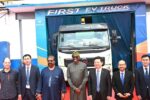
The Commissioner for Commerce, Cooperatives, Trade and Investment, Folashade Ambrose-Medebem, disclosed this at the closing ceremony of the 40th Lagos International Trade Fair, organised by the Lagos Chamber of Commerce and Industry (LCCI), at Tafawa Balewa Square, Lagos, on Sunday.
She said achieving the economic target would require sustained collaboration between the government and private sector, increased productive investments and stronger local industries.
“Our ambition is to grow the Lagos economy to between $800bn and $1tn by 2052. Achieving this target will require sustained collaboration between government and the private sector, increased productive investments, stronger local industries and an enabling business environment,” she said.
According to a statement by the ministry’s Director of Public Affairs, Abimbola Salehu-Badejo, Ambrose-Medebem stressed that the administration’s economic vision went beyond attracting investments to ensuring they translated into productive capacity, technology transfer, decent employment, stronger local value chains and improved livelihoods.
She disclosed that the 10-day trade fair attracted more than 50,000 participants, thousands of exhibitors and business delegations from over 20 countries, describing the 40th edition as a celebration of four decades of trade, economic growth and international connections.
The commissioner said the ministry had continued to strengthen its engagement with the organised private sector, support micro, small and medium-sized enterprises (MSMEs), empower cooperatives and expand access to business and investment opportunities.
She added that the ministry had facilitated business-to-business engagements, supported MSMEs seeking new markets and showcased indigenous businesses through the Lagos State Pavilion, which featured enterprises in agribusiness, fashion, manufacturing and the creative industries.
Ambrose-Medebem further disclosed that the state, in partnership with Afreximbank and other organisations, had trained more than 2,000 Lagos-based MSMEs in export readiness and market access to prepare them for opportunities under the African Continental Free Trade Area (AfCFTA).
She emphasised the importance of equipping local businesses to compete across the continent, saying: “Made-in-Lagos products must meet international standards and be competitive enough to access the opportunities presented by the African Continental Free Trade Area and other global markets.”
Highlighting the infrastructure supporting the state’s economic ambitions, she identified the Lekki Deep Sea Port, Lekki Free Zone, Blue and Red rail lines, and expanding road networks as critical assets strengthening Lagos’s position as a logistics, manufacturing and international trade hub.
The commissioner also announced plans by the ministry to lead a delegation of Lagos businesses to China under the Lagos State Export Readiness Programme to establish strategic partnerships and explore opportunities in international markets.
She said the state was equally preparing to host the Intra-African Trade Fair 2027 from 5 to 11 November 2027, describing the event as an opportunity to showcase Nigerian businesses, attract international investors and deepen trade across Africa.
The fair is expected to attract more than 100,000 visitors and 2,500 exhibitors from over 100 countries, with projected trade and investment deals valued at $50bn.
Earlier, Governor Babajide Sanwo-Olu, represented by the Secretary to the State Government, Abimbola Salu-Hundeyin, reaffirmed the administration’s commitment to strengthening local industries, expanding export opportunities, promoting enterprise development and attracting productive investments.
The governor described the 40th edition of the trade fair as a significant milestone in Nigeria’s commercial history, commending the LCCI for sustaining the platform over four decades and providing businesses with opportunities to showcase products, establish partnerships, attract investments and explore new markets.
Sanwo-Olu said Lagos was determined to move beyond being a major centre for buying and selling to becoming a stronger hub for manufacturing, value addition and exports.
He highlighted the state’s enterprise development initiatives, including the Lagos State Industrial Policy 2025–2030 and the N10bn LASMECO financing arrangement, designed to improve access to affordable capital for cooperative-backed businesses.
He also identified investments in transportation, electricity reform and improvements to the business environment as essential to supporting private-sector growth.
The governor noted that Lagos emerged as Nigeria’s best-performing state in the 2025 Presidential Enabling Business Environment Council (PEBEC) Subnational Ease of Doing Business assessment, describing the recognition as a reflection of the administration’s efforts to create a more conducive environment for businesses.
In his remarks, the Permanent Secretary of the Ministry of Commerce, Cooperatives, Trade and Investment, Babatunde Onigbanjo, acknowledged the contributions of the LCCI, exhibitors, sponsors, participating countries and development partners to the success of the trade fair.
He reaffirmed the ministry’s commitment to working with the organised private sector to strengthen local production, improve business competitiveness, expand market access and create sustainable economic opportunities for residents.